


Page 9 - The Collector's Companion: Issue CC101
P. 9
The Soundtrack to Windrush


       Mid 1960s to late 1970s ska and reggae record labels

       The  records  pictured  overleaf  are  from  a  collection   On the sun and sea colour palette...
       owned by DJ and graphic designer Shernette Daly, who   The JA labels depict a broad spectrum of colours from
       worked for seminal reggae label Trojan Records in the   the vernacular and heritage of the Caribbean. The West
       noughties. Here’s extracts from my interview with her.   Indies is on the whole a very colourful place and this
       The full interview along with many more images and a   translated through to the label designs which occurred
       YouTube playlist can be found on our website.  on JA/US/UK pressings. In the 1960s the UK was still
                                             a very grey place, recovering from the war, so an injec-
       On Windrush and integration...        tion of colour would surely have been welcomed.
       My parents are both from the Windrush generation so
       I have first-hand knowledge of their experiences of liv-  On the prevalence of graffitied names/notes...
       ing in London. Enoch Powell’s Rivers of Blood speech   The names and numbers scribbled on records adds to
       fuelled fear amongst Caribbean communities, encour-  their charm and provides individuality in my opinion.
       aged  segregation  and  condoned  violent  behaviours.   These notes can provide details about the provenance
       Ska music encouraged integration as there wasn’t a lot   beyond the place of purchase of each piece – telling
       going on socially in the UK. British people with rebel-  us  a  little  about  the  previous  owners.  Some  of  the
       lious attitudes during the mid ‘60s could identity with   scribbles also help to identify which side to play as
       genres such as ska and rocksteady, but from research   some pressings were incorrect or had a better b-side.
       and my conversations with relatives, I found the music   My father added ‘73’ to all of his vinyls, when I ques-
       scene still had a huge divide.        tioned why he had chosen this number he stated that it
                                             was a great and happy year for him living in the UK but
       On appealing to the white working class skinheads...  also made his records distinguishable... but it didn’t
       All of the reggae record label designs use strong visual   stop him losing a large proportion of his collection!
       communication  with  memorable  names,  typography,
       symbolism and colour palettes. I think UK labels such   On what makes a record valuable...
       as Punch (active between 1969-1975) had a distinc-  As a collector, you try to obtain the original JA press-
       tive  and  very  powerful  language.  Punch’s  illustrative   ing, these are the most sought after records. Because
       fist combined with the textured news print perhaps did   I am a designer and have always appreciated the label
       appeal to the Skinheads. If we were to compare this   designs, I have consciously tried to collect the ones I
       to another UK label such as the Giant ska label, there   want - as many as I can!
       is a completely different tone of voice again, with no
       graphic references to JA, so we could indeed assume   On the changing collectors’ market...
       this was a deliberate strategy to appeal to a British   The value of some records have increased consider-
       audience. The design may have been created with a   ably and some of the hidden stores I personally visit
       specific intention, but it was all about the music.  have now been discovered by many, so it’s much more
                                             difficult to find specific tunes. With reggae, I would say
                                                there are less original pressings in circulation be-
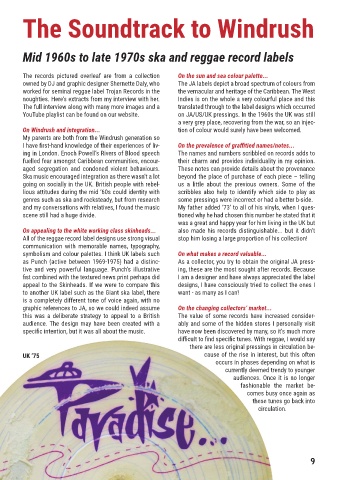
       UK ‘75                                       cause of the rise in interest, but this often
                                                       occurs in phases depending on what is
                                                         currently deemed trendy to younger
                                                           audiences. Once it is no longer
                                                             fashionable  the  market  be-
                                                              comes busy once again as
                                                                these tunes go back into
                                                                 circulation.


 8  For days out ideas visit our website: www.thecollectorscompanion.co.uk    9

