


Page 24 - The Collector's Companion: Issue CC103
P. 24
Loose limbs telling time                                                                                       Rubber hose style


       Making the 1930s a time to smile
                                                                                                                                        Simple shapes for working quickly
       In 1932 a 28-year-old designer named Earl Arnault, from   There  really is no mistaking these  early cartoons,
       Oregon, USA, invented a clock to bring some cheer to   wonderfully surreal, at times disturbing, there would                    Conjoined and/or (slice of) pie eyes
       a country in the midst of The Great Depression. This   be nothing surprising about  a cupboard opening
       clock came in the form of a cat with a “wagging tail,   its own door to hand the  homeowner  the contents,
       rolling eyes, and contagious smile”.  or for a bird’s beak to take on the form of a musical                                               White gloves for clarity
                                             instrument  as it sang.  Just  like the  Busby  Berkeley
       At this time the comic strip and animated film market   films of the 1930s that used dancers’ bodies to create
       was  saturated with b&w cartoon  cats  making  it an   dazzling  kaleidoscopic  displays,  the cartoons  fed                              Bendy, stretching limbs
       obvious choice for  Arnault  to achieve the  feel-good   into America’s  insatiable desire for escapism from
       factor. The most famous of these was Felix the Cat   their  real-life  troubles.  I am  most  fond  of  Fleischer
       (1919) but there were also Krazy Kat (1913), Julius the   Studios’ Betty Boop cartoons featuring Cab Calloway,                        Little or no detail in clothing
       Cat (1922) and Waffles (1921).        the combination of the animation and the soundtrack
                                             capturing the mood of the era so perfectly.
                                                                                                                                                   “Mickey had to
                                             It  would  be  wrong to talk about  famous animated
                                             animals of the  20s  and 30s  without  mentioning the                                                  be simple. We
                                             biggest (yet smallest!) of them all – Mickey Mouse.                                                  had to push out
                                             Walt Disney  created  Mickey  having  lost  the rights
                                             to  his  previous  character, Oswald  the Lucky  Rabbit                                               seven hundred
                                             (created  by Walt  for  Universal Pictures in 1927).
                                             Mickey’s  early  appearances  make full use of the                                                 feet of film every
                                             rubber hose style, where stretching and bending limbs
                                             play a crucial role in what the characters are able to                                                   two weeks.”
                                             do. While Oswald disappeared quite quickly, and Felix                                                            Walt Disney
                                             failed to find success in the sound era, Mickey is the
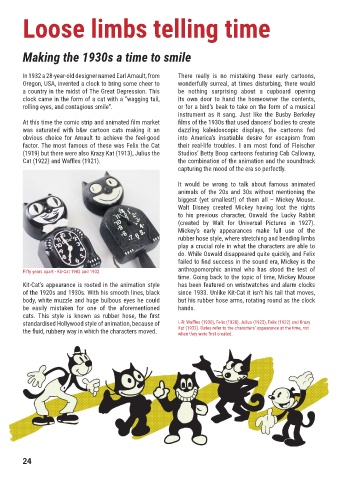
       Fifty years apart - Kit-Cat 1982 and 1932  anthropomorphic  animal who has stood the  test  of
                                             time. Going back to the topic of time, Mickey Mouse
       Kit-Cat’s appearance is rooted in the animation style   has been featured on wristwatches and alarm clocks
       of the 1920s and 1930s. With his smooth lines, black   since 1933. Unlike Kit-Cat it isn’t his tail that moves,   Right: 1978 Bradley alarm
       body, white muzzle and huge bulbous eyes he could   but his rubber hose arms, rotating round as the clock   clock with internal bell,
       be easily  mistaken for  one of the  aforementioned   hands.                        rotating arms and nodding
       cats.  This  style  is  known  as  rubber  hose,  the  first                        head. Made in Hong Kong.
       standardised Hollywood style of animation, because of   L-R: Waffles (1930), Felix (1928), Julius (1925), Felix (1922) and Krazy
       the fluid, rubbery way in which the characters moved.   Kat (1932). Dates refer to the characters’ appearance at the time, not
                                             when they were first created.


                                                                                                  Visit our website for our
                                                                                                  1930s cartoons playlist!


       24                                                                                                                                                        25

