

You may be familiar with artist Ai Weiwei from the sea of 100 million hand-painted porcelain sunflower seed husks in Tate Modern’s Turbine Hall, his Lego portraits or perhaps from his secret detention by the Chinese authorities in 2011 which sparked a very public campaign to free him.
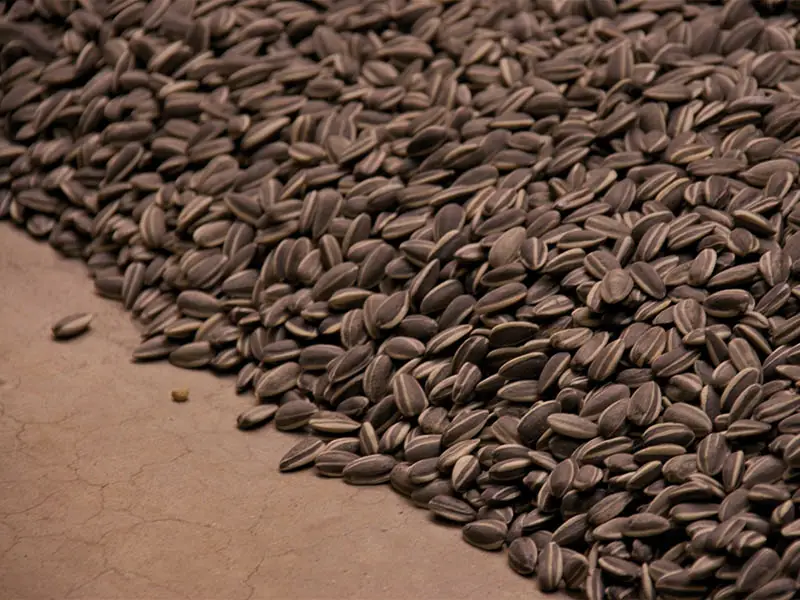
Ai considers himself a collector, but it isn’t collecting in the way we usually deal with in this magazine. Last issue we featured a large collection of jewellery that was the norm in that each piece of jewellery was different. For Ai, collecting as an artist has meant the mass accumulation of (not quite) identical objects.
As an individual, Ai’s enjoyment and success as a collector came from wanting the right thing at the right time. In the early 1990s he started visiting the antiques markets of Huangcungen, Beijing. He was drawn by the large quantities of Neolithic items available, items nobody wanted that he was able to buy very cheaply.
“Dealers found me perplexing, for I followed no prevailing tastes or conventional wisdom. Instead I was taken with obscure objects, and made a point of buying things that seemed to have little or no value.”
Ai Weiwei: Making Sense (2023)
Three of these collections were presented in the Design Museum’s 2023 exhibition, ‘Ai Weiwei: Making Sense’, as vast fields across the floor.
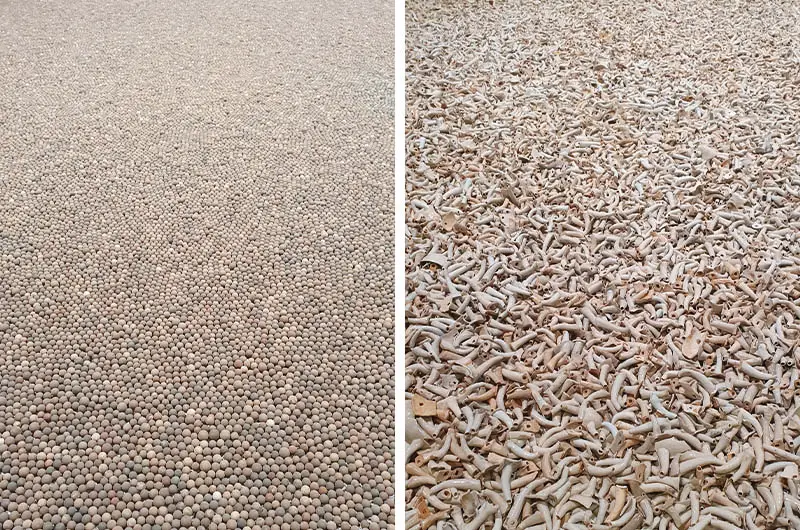
Untitled (Porcelain Balls): A field of 200,000 cannon balls made during the Song dynasty. Interestingly, the highest-quality porcelain (Xing ware) of the time was used to make quite literally, throwaway items.
Spouts: This field hints at the massive scale of porcelain production in China during the Song dynasty (960 – 1270 AD). Heaped together are over 250,000 porcelain spouts from hand crafted teapots and wine ewers. During production, if the pot wasn’t perfect, the spout was broken off.
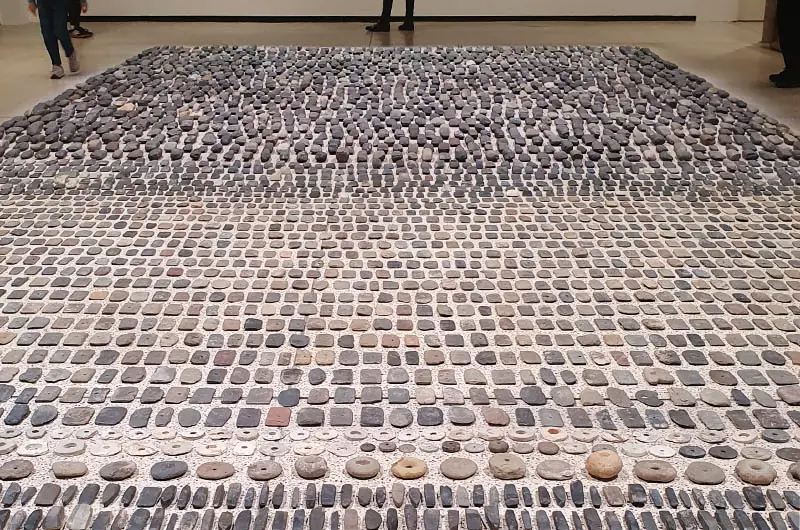
Still Life: A ‘terrain of forgotten know-how’, this field is an organised display of 4,000 tools dating from the late Stone Age, including axe-heads, chisels, knives and spinning wheels, serving as a reminder that the origins of design are rooted in survival.
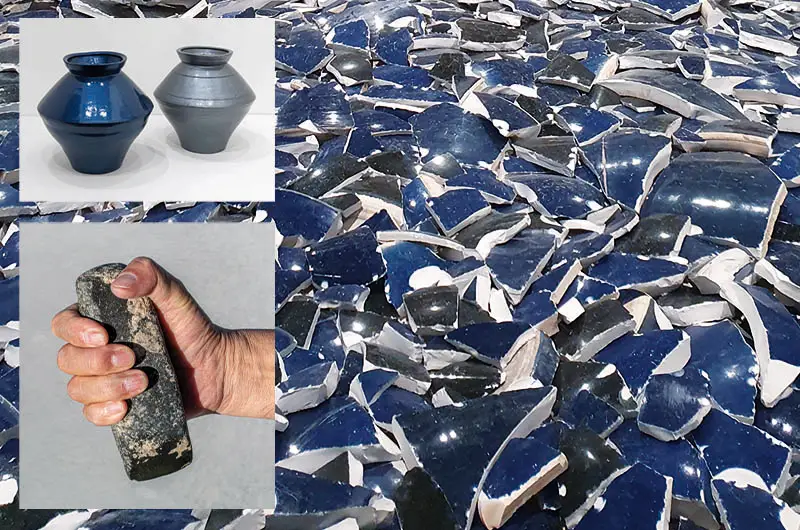
They were presented alongside a fourth field that consisted of thousands of fragments of porcelain sculptures – sculptures made by Ai that were destroyed when the Chinese state demolished his Beijing studio in 2018. The field lies as evidence of the repression Ai suffered at the hands of the Chinese government. It also taps into what makes Ai’s collecting, and the scale of it, so significant.
In 1958, when Ai was only one-year-old, his family were exiled by the authorities due to his father, Ai Qing, being a prominent poet. They remained exiled, with his father working forced labour, until the end of the Cultural Revolution in 1976. He grew up witnessing China being purged of its Four Olds – old ideas, old culture, old customs and old habits.
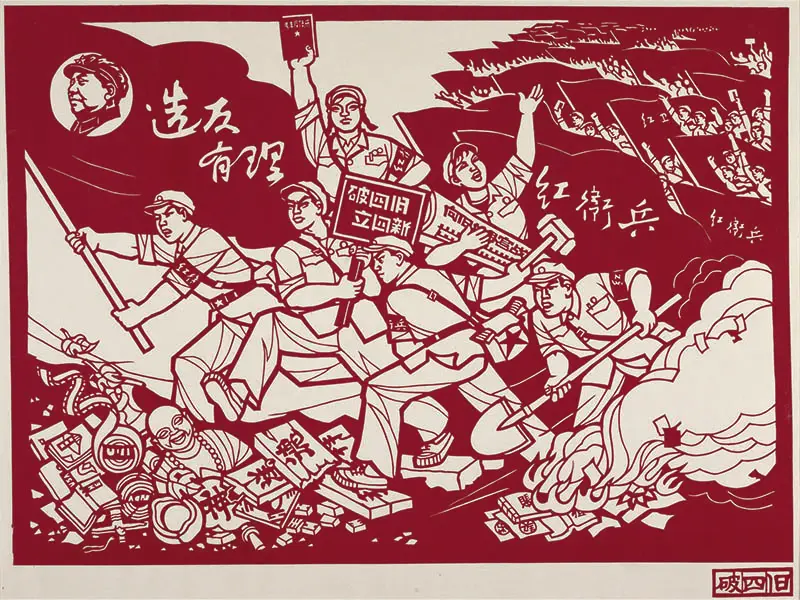
For Ai, to collect is to speak out against the Cultural Revolution. It is an act of resistance. His field of Song-dynasty teapot spouts is interesting because the spouts are the opposite of objects to be remembered or revered. They are the rough drafts thrown in the writer’s wastebasket. In their quantity, they demonstrate the craftmanship and expectations of perfection by their makers as much as seeing a singular perfectly finished teapot would. A singular teapot tells us of its purpose, of its fashion, but 250,000 spouts tell us about industry and demand, of labour and discipline.
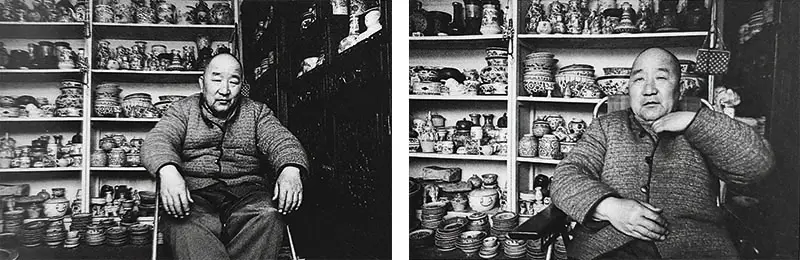
“Any one of these might be a museum piece, sitting in a glass case with a label that reads: ‘Chisel, c.4000 BCE, stone’. But here are thousands of them, with no labels, cases or other museological garnishes. We are not used to seeing them assembled in such numbers. They have been derarefied.”
Justin McGuirk, One Hundred Thousand Things in Ai Weiwei: Making Sense (2023)
If we could take all the Staffordshire dogs or SylvaC bunnies from every antique shop in the country and place them all into one room, would their value and appeal be diminished? The Vinterior website shouts, “discover one-of-a-kind pieces”, but of course, they’re not, or at least, they weren’t.
Outside of the art world, reminding a buyer that an item was once part of a flourishing production line is usually something to be avoided, unless that item has become singular again – you used to be able to find thousands of these, but now there are only a few left, how lucky you are to have found it.
The sweet spot between the appeal and lack of appeal in quantity is one that dealers learn to find. How many duplicates are needed to create an attention grabbing display without taking away from their uniqueness? In fashion retail, think about how many of a particular garment you’ll see on a rail in Primark compared to Selfridges. An expert in retail stock management told me that a brand like Gap will place no more than one of each size (plus an additional S/M/L) on a rail. The more expensive the brand, the sparser the rail.
Consider the last antique impulse buy you made. What words ran through your head when you saw it? Special? Different? Unique? Our willingness to view an item as unique is invariably linked to our knowledge of it. Either we know it is unique due to some variation, anomaly or by trait of its origins, or we think it to be unique because, quite simply, in that moment it is.
The more knowledge we have of an item, the more ways we have of seeing it. How many times have we seen something labelled as, “a fine example of…”? Seeing an item as one of quantity gives us the opportunity to appreciate its place in history. It puts us in a museum frame of mind, where we’re able to appreciate an item without necessarily liking it.
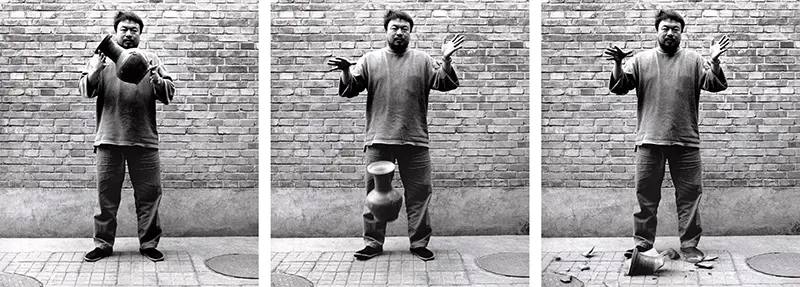
One of Ai’s most controversial art pieces is a triptych of photographs capturing the moment Ai (purposefully) dropped a Han dynasty (206 BC–220 AD) urn. On the surface it is pure vandalism but in the context of Ai’s experiences of the Cultural Revolution it is an act that asks its viewers to consider the importance of preservation. Ai’s defence for destroying the urn was that its insignificance due to its quantity outweighed its significance due to its age.
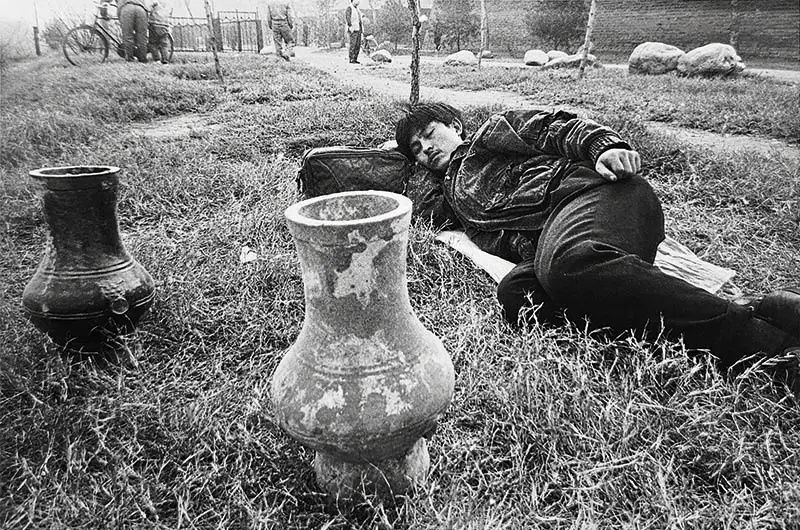
“There are hundreds of thousands of similar Han dynasty vases, and you can easily buy them. I still have a photo of when I was in Xi’an. There was a farmer sleeping on top of these two urns waiting for someone to pay him a few hundred yuan. For him that was a few month’s salary, but even then nobody wanted them. So [to me] the act is not like I destroyed a Rembrandt, it’s not like there is a limited number.”
Ai Weiwei interviewed by Tiffany Wai-Ying Beres, “A Battlefield of Judgments: Ai Weiwei as Collector,” Orientations 46, no. 7 (2015)
It reminds me of my brief dalliance with archaeology – when my husband and I moved into our home and dug over its overgrown garden. The first piece of clay smoking pipe we found was interesting, the second slightly less so. By the time we’d reached the fiftieth, or a hundredth, we were making judgment calls on whether each unearthed piece was good enough to be worth bending over to pick up.
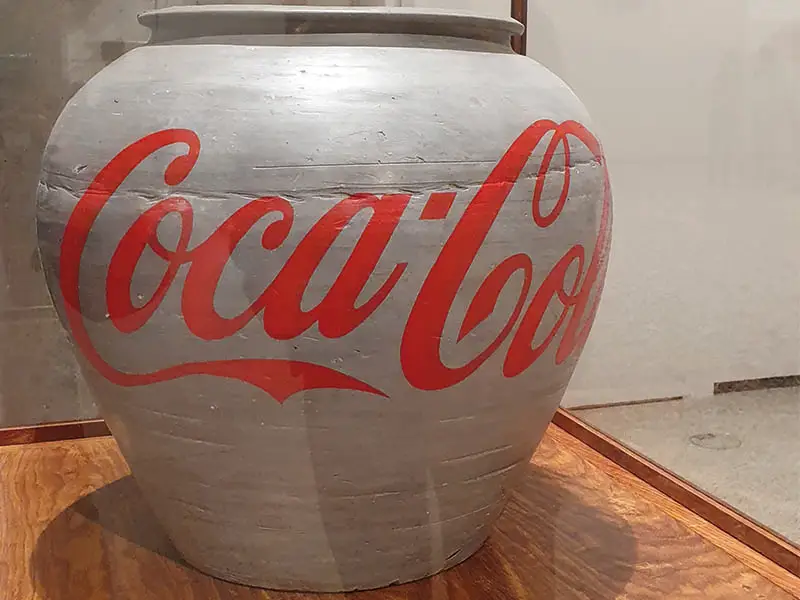
As well as dropping a Han dynasty urn, Ai has also ‘upcycled’ many urns over the years. Some are dipped in brightly coloured paints, which horrifies a great many people, but bearing in mind his quote above, a 2000-year-old urn dipped in paint ought be no more horrifying than a 1950s dressing table being covered in decoupage. Two of the most interesting versions of the urns series are Coca-Cola and Auto Paint (pictured further up) because both apply modern consumerism and factory sensibility onto an urn which itself was once churned out in the same way.
In the world of modern collectables we are led to believe that quantity is not desirable. Each Funko Pop release can exceed 20,000 figures, with variants and Con exclusives being highly sought after for their lower production quantities. Open a pack of trading cards and you’ll find them split between Commons, Rares and Ultra Rares. Yet the museum displays of tomorrow are likely to be the opposite. The Science Museum collects historically significant items such as the Sony Walkman and the Nokia 3310. Providing we don’t send it all to landfill, it will surely be the non-rare items that come to matter hundreds of years from now.