
“Labubu fan fury after dolls pulled from Pop Mart stores over fights”, “Labubu dolls make up 90% of fake toys seized at UK border”, “Disturbing reason people are now burning their Labubu dolls” (they are possessed by an ancient demon). All fads generate content and today even more so with the relentless churning out of online ‘news’.
“My buyer’s guilt is insane. It’s $1,300 on trash.”
The article beneath this third headline piqued my interest when the phrase, “hyperconsumption of collectable toys” appeared between the tales of buyer’s remorse. It suggested that we were in the midst of a dangerous new craze, “akin to gambling”, and referred to collecting (of any kind) as a “very compelling habit.”
In making links to gambling, this, and other news articles, would refer to academic research into in-(video)game purchasing, which had been the last big talking point by the media on this topic, when a botched online post from video game publisher Electronic Arts (EA) caused a furore that began on Reddit and finished(?) in Parliament. (More on that later.) Suddenly, the question was being asked, should this be regulated?
The cause of all these upsets? The blind box. Are you familiar with the term? To ensure we’re all on the same page, a blind box is a collectable contained within sealed, opaque packaging, to keep its identity a mystery until after purchase. It is typically part of a themed series.
Labubu dolls weren’t the first thing to pop out of a blind box. If you explore the roots of surprise gifts, they go back over a hundred years and are as much about administrative ease as they are a money-making opportunity. The toy pages of Argos were filled with unintentional blind boxes to save them the hassle of assigning each doll or action figure variation with its own item code and listing.
Jurassic Park Dinosaurs Assortment. Each dinosaur has its own special feature. You will get either…
Hey! What do you mean I’ve got a Coelophysis? I wanted the Velociraptor! Where as the Argos method of blind boxes was probably undesirable to most children (and the cause of many a squabble at the collection point), other, more intentional, mystery toys were highly appealing.
Notable examples of ‘bottom of the box’ mystery gifts are cigarette cards and cereals. With cereals particularly, we see the use of children to drive adults’ purchasing decisions, the toy merely being the hook to ensure customer loyalty.
The 1970s gave birth to all sorts of blind boxes, most of which are still popular today and was the time period when we saw a real split from mystery toys as a fun bonus, to being the main draw. How much it was intended by manufacturers and marketeers to drive multiple purchases by ‘collecting’ is hard to say (and dependent on how much of a cynic you are), but it was inevitable that the collectable aspect would move to the forefront over time, getting to the stage where the series size and purchasing method would be actively manipulated to encourage overbuying.
At this point, let’s take a break for a whistlestop tour through 100+ years of blind boxes… or, skip ahead to carry on with the article.

Breaking open a cookie to receive a fortune has an origin that zig-zags between Chinese and Japanese traditions. At the start is kau chim, a Chinese fortune telling practice dating back to the Taoist and Buddhist temples of the third century. A numbered stick is drawn from a pot, which corresponds to one of the hundred written fortunes. It is thought kau chim was imported to Japan some seven or so centuries later, with the fortune seeker taking a fortune written on a strip of paper from a box, known as omikuji.
Fast forward another seven or so centuries, and a flavoured, folded rice cracker holding a fortune, called tsujiura senbei, is developed in Kyoto Japan before making its way to San Francisco in the 1890s with Japanese immigrants. One theory on the origin of the modern Chinese fortune cookie is that Chinese-owned manufacturers took over production during WW2, when Japanese businesses were closed and Japanese-Americans were sent to internment camps.

Crackers are one of the many Victorian-era Christmas traditions that continue today. Crackers started in the 1840s as paper-wrapped bonbons sold at Christmas by a London-based confectioner, Tom Smith. A motto was added inside the wrapper to try and add year-round appeal. Next, the ‘crack’ was added and the name cosaques was given, after Cossack soldiers firing their guns into the air. This new cardboard tube format enabled the inclusion of a small gift and hat.
Though not collectable per se, crackers were marketed on their theme or gift. One example is Thomas Watson and Co. in Sheffield who, in 1878, were advertising “novelties in Japanese cosaques, consisting of fans, umbrellas, etc.” A 1904 newspaper writeup lists a few of the varieties on offer that Christmas. They included the “Frolicsome Frogs”, containing tiny frogs for children and the “Dutch China” set containing “pretty little china mugs, jugs, vases, and so forth.” They also mention the “Louis Wain Cats” set, designed to attract those seeking art cards from the popular illustrator.

From fuku (good fortune/luck) and fukuro (bag) – there is fortune in leftovers. Often cited as the original blind box, fukubukuro began in the kimono district of Nihonbashi, Edo (now Tokyo) in the 1860s. Offcuts of cotton for kimonos, which had accumulated throughout the year, were placed into bags and sold off at a discount. This useful and popular sales tactic grew into a New Year tradition across Japanese retail.

Cigarette cards started life as a box stiffener, quickly developing into a loyalty scheme. Starting in the US, then in Britain in the 1880s, the printed art cards nicely fitted in with earlier Victorian trends of visiting cards and scrapbooking (see here). A 1909 newspaper alerted its readers that “the demand for photographs of football players is well catered for in a new brand of cigarettes”, calling it a “collection well worth having.”
Brand loyalty wasn’t only achieved by its purchaser (or perhaps their children) wanting to obtain certain cards, but by casting the appeal of the artwork aside and treating them as currency with loyalty exchange schemes. In the 1930s, each Player’s art set had its cards numbered one to fifty, and any complete set of numbers (even if from different themes) could be exchanged for gifts. It was also possible to fill a third-party collector’s booklet with a complete set on a particular theme to order to receive 1/6 in remittance upon handing over the completed booklet.

Kellogg’s started giveaways with cereal only three years after the launch of Corn Flakes, with an interactive children’s book called The Funny Jungleland Moving Pictures Book in 1909. Often updated and re-issued, it was offered by mail-in until 1937.
The first in-packet prize didn’t come until 1943. 36 pin badges depicting the badges of different US WWII squadrons could be found inside boxes of Kellogg’s Pep. These were followed with sets featuring popular characters such as Superman.
In-packet (as opposed to back-of-packet or mail-in) giveaways arrived in the UK with Kellogg’s and Quaker in the late 1950s. A part of branded cereals for decades to come, they dwindled away with the introduction of the 2005 Children’s Food Bill.

A 1974 Daily Mirror article opened with the question, “can you imagine everybody you know at school being mad keen to collect fifty pictures of TV stars, pop singers or British castles?” suggesting that the phenomenon of collecting cigarette cards was a most peculiar and outdated pastime. Odd, considering that since a few years before, multiple companies had been producing football stamp/sticker albums, including the Daily Mirror!
By the 1980s, sticker albums were produced for all the popular fllms and TV programmes, by Panini (formed 1961), Topps or the national newspapers. With numbered blank boxes on each page of the album, the format drove the desire for completion – particularly if you were unlucky enough to have only collected three quarters of Kylie’s face!
Most TV/film albums needed between 180 and 250 stickers to complete, with the ability to send off for a limited number of missing stickers for a small fee.

Kinder Surprise, for many Gen X’ers, would be their first experience with the blind box. It was launched in 1974 by Ferrero, inspired by the Italian Easter tradition of gifting a large chocolate egg with a toy inside.
Over 100 toys were included, on no particular theme. With such a large number in rotation, the emphasis was on knowing there was a different toy every time. Collaborations with Disney and Asterix were quick to follow (from 1976), but the toys were were amongst the 100, so not guaranteed. Seasonal additions of branded or in-house sets were the hook in marketing, but there could be no reasonable expectation of actually collecting them all. In fact, it wasn’t until the mid-1990s that the enclosed toy leaflet was likely to include images of the complete seasonal set.
These days, the most efficient way to complete a limited edition set is to buy boxes of three eggs, of which one should contain a ‘special’.

Happy Meals arrived in McDonald’s in 1977, the idea coming off the back of cereal box prizes. Much like Kinder Surprise, the initial toys were a fairly random selection, but within two years they had their first licenced tie-in for Star Trek: The Motion Picture. Each of the five contained different a number of items, with the box itself decorated with a five-part comic story.
In recent years, McDonald’s has introduced adult Happy Meals, the first in the UK was released to much fanfare in March last year with six Minecraft-themed toys to collect. This February, a Friends-themed meal launched with six Friends character figurines.

Gashapon marks the beginning of the modern blind box format. A Gashapon is a giant gumball machine, versions of which you may have come across in supermarket foyers. It was an idea that was born in the US but it took off in Japan in the 1970s. The biggest manufacturer of these toy capsules is Bandai Co. (who trademarked Gashapon), who got the Guinness World Record for producing over 220 million units in 2024 – an unsurprising amount when you consider that in Japanese cities you can find dedicated capsule shops with wall-to-wall machines.
The average Gashapon costs between (roughly) 50p – £2.50 and there’s usually between four and ten in a set. The online version allows you to see which Gashapon have already been dispensed from a machine. The name comes from the sound of the machine. First the crank (gasha), then the drop of the capsule (pon).

CCGs are collectable card games, such as Magic: The Gathering (from 1993) and Pokémon (from 1996). For the uninitiated, I will risk angering the players by describing collectable card games as a very complex version of Top Trumps where you keep your own deck of cards. A player adds to their starter deck with the purchase of booster packs, containing random cards of varying rarities. Just as Top Trumps has cards of different powers/strengths, so do CCGs, the rare cards being higher skilled than common ones.

As an aside, it is worth mentioning loot boxes. Much of the discourse and acedemic research around the dangers of blind boxes has been based upon loot boxes.
Loot boxes are as named – boxes of loot, which are purchased in video games with real money or in-game currency. They may contain weapons, armour or fun upgrades to give the player an in-game advantage or customise their gaming experience. They came from the need to monetise free-to-play online games and have been subject to attention from governments and authorities around the world, including the UK, to determine whether they constitute gambling and should be legislated as such.

In 2010, Lego launched its first set of collectable minifigures. Each bag contained one of sixteen newly designed figures. The selection of figures were specifically designed to appeal to both children and adult collectors. To date, there have been 49 series released.
Keen collectors could bypass the blind bag system for the first two series, with figure-specific barcodes included on each bag. After that, collectors had to rely on feeling the bags for uniquely shaped pieces. On a visit to the Lego Store on launch day you would find staff expertly feeling their way over multiple bags, calling out their finds to the crowd of less nimble-fingered buyers – “Princess Aurora! Pinocchio!”
Lego subsequently became more aggressive in pushing the blind bag format, switching to sealed boxes for their 43rd release. Although it was possible to scan the box’s QR codes with unofficial apps to identify the contents, Lego perhaps hadn’t anticipated how many average buyers there would be who had no intention of buying blind. Boxes are frequently found torn open in shops resulting in some shops choosing to place them in locked cabinets.

Pop Mart is the over-achieving child of blind box collectables, home to Labubu and other popular IPs. The viral popularity of Labubu is what’s brought blind boxes to the attention of mainstream press and like all good fads it has faced shortages, fighting customers, occult-related bans and fakes flooding the market.
Pop Mart’s figurines, plush dolls and plush pendants (keyrings) are sold in series of anywhere between six and sixteen, with equal rarity but often with an additional secret edition available at much lower odds.
With their price point higher than the typical pocket-money blind box toy, Pop Mart began to make whole sets available for sale since 2023. When buying a whole set (in the outer box you’d usually see on a shop shelf) Pop Mart guarantee no repeats, and the chance that one of the main set will instead be the Secret.
In probability theory, it is known as the Coupon Collector’s Problem. How many times does an item have to be drawn until each one has been drawn at least once? It’s more advanced than the old ‘odd socks’ puzzle (in a dark room, with an equal number of black and white socks to pick from, how many socks do you have to pick to guarantee a pair?) because unlike the socks, you’re not removing anything from the drawer – the full set is available for every pick. Fortunately for me, these days there’s a number of online calculators available to do the sums.
LEGO Animals Series 28
TO GET: 12 figures
BOUGHT: 37 figures
£129
McDonald’s Friends Meal
TO GET: 6 figures
BOUGHT: 15 meals
£136
Kinder Surprise DC Playmobil
TO GET: 16 figures (1 per 3 pack)
BOUGHT: 162 eggs (54 packs)
£162
Panini Barclays WSL Official Sticker Collection 2026
TO GET: 511 stickers (5 per packet)
BOUGHT: 3,483 stickers (697 packets)
£697
Pop Mart Crybaby Crying to the Moon Series
TO GET: 12 figures +1 Special Editon
BOUGHT: 144 figures
£2,016
Where were we? The 1970s and the birth of the modern blind box format. I would be very surprised if there was someone reading these pages who hadn’t experienced the blind box, even prior to any current interest in collecting. You’ve surely looked on with envy as your other half’s cracker gifts them the twisty metal puzzle while you’re the ‘winner’ of three plastic golf tees (My Christmas 2025: A True Story).
Which sticker album was the currency in your school’s playground? The Panini sticker album led on from cigarette cards with a format that demanded completion. It makes for a great case study, having been linked by some academics to the Zeigarnik effect – the 1927 psychological theory that people remember unfinished or interrupted tasks better than they do completed ones. They argued that “a missing sticker space is much more salient in a collector’s memory than those already filled.”¹ This goes hand in hand with the theory that we are driven to complete sets. How can a half-filled Panini album be enjoyed with all those white rectangular voids on every page?
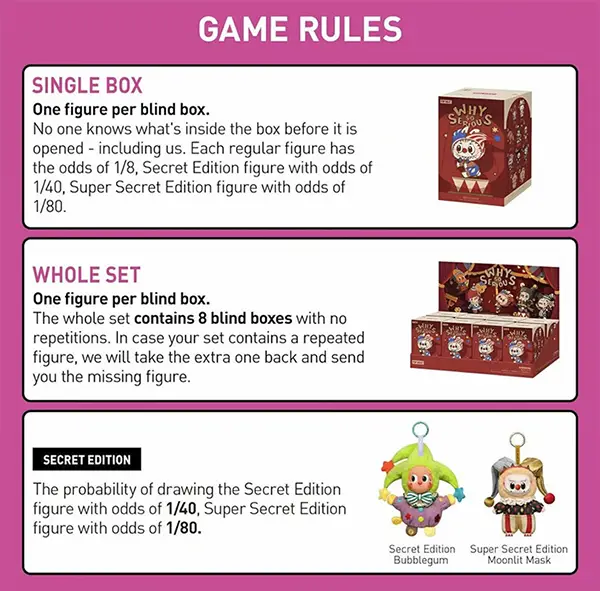
The need to complete once we’ve been sucked in is understandable, but what’s the appeal of starting in the first place? One consideration is that we’re naïve to the process, much like buying the 99p first part of a Build Your Own Titanic magazine, not realising it will take 130 issues at £7.99 a month to complete. For all the moaning about Labubus, Pop Mart is the most transparent of all the formats with the odds (or as they call them, “game rules”) displayed on every box. This was required by 2022 Mystery Box Compliance Guidelines in Shanghai. Giving the odds is helpful, but as the “coupon collector’s problem” shows, it is a long way off making clear the typical expenditure needed to complete a set.
The boom in blind boxes (Pop Mart posted a near 400% surge in net profit last year) persuasively tells us that people quite simply enjoy the surprise.
Why spend your hard earned money without knowing what you’re going to get for it? Maybe this is a good time to admit that personally, I’m not a fan of the format. I like to choose the item I want, and buy it. Yes, I have a minifigure scanning app on my phone.
But, the scanning app is a hassle, and in fact, isn’t buying anything at all a bit of a hassle now? We used to have the choice of six microwaves on a shelf in Curry’s and now we have dozens on Amazon and need to doom scroll through hundreds of reviews else know it was our own stupid fault for buying a dud.
In a stressful, modern world where we’re bombarded with information, there is pleasure to be had in eliminating the pressure of making a decision. The rise in letterbox subscriptions (monthly deliveries of socks/tea/books/flowers/you name it) supports this.
Uncertainty marketing refers to the practice of withholding information in order to engage consumers², the opposite of what was generally understood previously. This is the real nitty-gritty of concerns around blind boxes. It’s about the experience.
“It’s not just you click a button and then there you go you’ve got it – there’s a lot of, like, animation that comes with it and that’s quite, like, exciting and thrilling for me.”³
The thrill of unwrapping no longer only relies on the physical task (yes, manufacturers will have considered how their packaging appeals to our different senses – the look, the feel, the sound – Gashapon is named for it!), as modern technology enables a full games arcade experience. Gashapon (Japan) and Pop Mart, both offer a pre-delivery virtual unboxing accompanied with bright spinning animations and exuberant sound effects. Pop Mart’s app asks you to draw a shape on screen during the unboxing to manifest the desired outcome (gambling comes with “illusions of control”³). Your purchase will be revealed prior to delivery, but you’ve already paid for it so there’s no hitting the back button if you’re unhappy with the outcome.
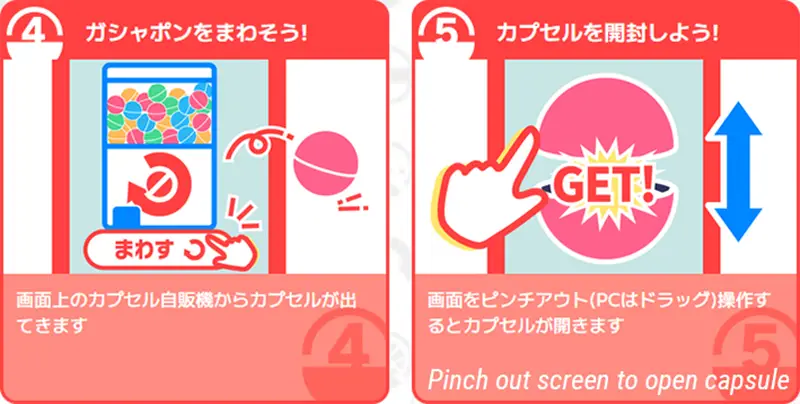
Knowing which figure you’ve ‘won’ ahead of delivery is likely to encourage over-spending. Not only do you not have to wait 2-3 days before trying again, but the negative outcome was (temporarily) virtual – you haven’t got that unwanted beige Labubu sat in your eyeline, mocking you with its toothy little grin while you drop another £16 trying to obtain the lilac one. It is known as the gamification of buying and that’s where we start to see the obvious links to gambling.
Technically, in the UK and in many countries worldwide, almost all types of blind box purchasing (except those where the toy is a bonus, such as Kinder) can be legally defined as gambling as they include three elements; consideration (the payment), chance and the prize. By this definition, the UK government could, if it chose to, follow Shanghai in restricting their purchase to minors. Congratulations son! You’re 18! Why not treat yourself to some Pokémon cards on the way to the pub?
#gotgotneed Panini
Gotta catch ‘em all! Pokémon
One person’s predisposition towards gambling may be increased under social pressure, all the more likely in the digital age. Unboxing videos are big business. Even those of us who find no pleasure in the potential disappointment of blind boxes can take great pleasure in watching someone else’s disappointment. Funnily enough, unboxing videos are part of Pop Mart’s rules – if you buy a Whole Set and receive a duplicate, then you’ll need your unboxing video as evidence to secure a replacement.
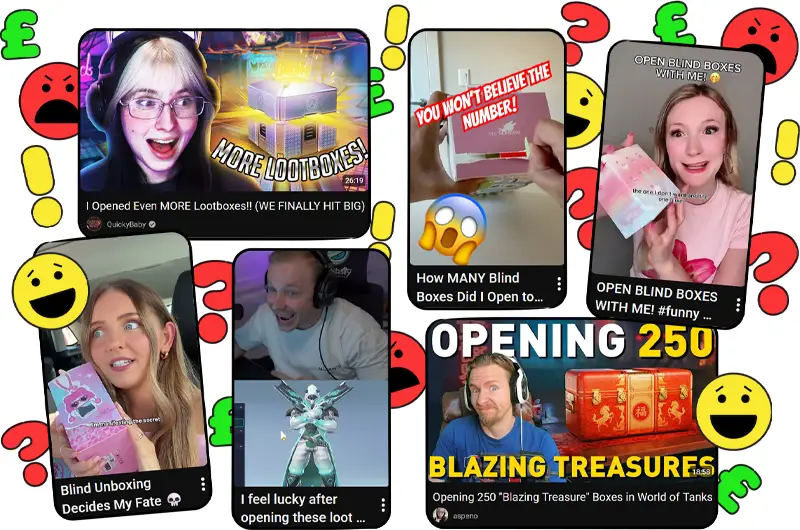
A person can experience feelings of achievement and self-worth if they are one of the lucky few to obtain a limited edition or sought-after piece. Surveys found notions of value were consistently linked with item rarity by participants.³
That brings us back to the Reddit/EA row. In 2018, a Reddit user posted, “Seriously? I paid 80$ to have Vader locked?” His ire referred to his discovery that the new video game Star Wars: Battlefront had not made Darth Vader a playable character until 60,000 in-game credits had been earned (through extensive gameplay or from trading loot box contents). The response from its makers, EA, actually won them a Guinness World Record for the “most downvoted comment on Reddit” (-683k), popularly referred to as “the most hated comment on the Internet.”
Seven months later, EA found themselves appearing before a House of Commons committee on the subject of ‘Immersive and addictive technologies.” There, their representative doubled down and attempted to downplay the links to addition, saying “[people] like surprises”, and was something that had been part of toys for years, likening loot boxes to Kinder eggs. Trying to frame their in-game purchases as “ethical and fun”, they said they didn’t call them loot boxes, they were “surprise mechanics”, which certainly did generate some fun, but unfortunately for them, it was in the form of an internet meme. Many felt the problem was, again, FoMO (fear of missing out). A Kinder egg is a toy, but a rare weapon in an online multiplayer game is aspirational.
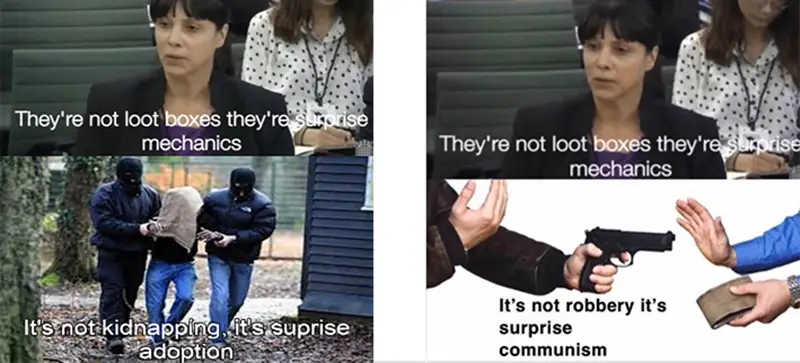
It is then, not so much the blind box format that is the problem, but how it has become embedded into our digital and social landscape, which, with its current lack of regulation, exposes children to potentially self-damaging behaviour. It’s the external pressures that push collecting beyond something that was previously a mostly private hobby.
Incidentally, after the 2019 committee hearing, the government chose not to legislate against loot boxes, agreeing there were links between the two, but the key sticking point being that the ‘prizes’ from loot boxes did not have real-world monetary value. If being seen to crack down on ‘video game nasties’ can’t persuade the government to legislate, then it is unlikely to happen for the physical blind box.
One thing’s for sure, apps and social media have created a new way to collect and have added to it going mainstream. It is time to swing open your front door, step outside and proclaim, “I am a collector!” and finally get some well deserved street cred… maybe.
Consumers are more likely to buy a complete set than they are an incomplete one (even if has been priced accordingly).¹ Thus, if pricing up three teacups and two saucers for sale, removing the third cup is likely to make the set more palatable.
Consumers enjoy uncertainty when the (monetary) risk is low.² Odds and sods can be repackaged. Staying on trend, don’t call it a lucky dip – call it a mystery prize! It’s time to return those Happy Meal toys to their roots!
Highlight the “experiential aspects” of an activity (“Enjoy this auction”) rather than its instrumental value (“This auction is a great way to get a good deal”).²

Sources:
- Bauer, C., Spangenberg, K., Spangenberg, E.R. et al. Collect them all! Increasing product category cross-selling using the incompleteness effect. J. of the Acad. Mark. Sci. 50, 713–741 (2022). https://doi.org/10.1007/s11747-021-00835-6
- Kovacheva, A., Nikolova, H. Uncertainty marketing tactics: An overview and a unifying framework. J. of the Acad. Mark. Sci. 52, 1–22 (2024). https://doi.org/10.1007/s11747-023-00941-7
- Close, J., & Lloyd, J. (2021). Lifting the lid on loot-boxes: Chance-based purchases in video games and the convergence of gaming and gambling. London, UK: University of Plymouth and University of Wolverhampton on behalf of GambleAware. Available from: https://www.begambleaware.org/sites/default/files/2021-07/Gaming_and_Gambling_Report_Final_0.pdf