

Skip to: Timeline / Fibre info / Burn test / Finishing treatments / Sources
The biggest revolution to take place in fashion was not one of style, but of fibre. The invention of synthetic fibres changed what it was possible to make, how long had to be spent doing the laundry and ultimately, our entire relationship with clothing, helping to create “fast fashion”.
Fashion, unimportant as it is in the grand scheme of things, wasn’t the driving force in the development of synthetics. The process used to make cuprammonium rayon was found through attempts to produce carbon filaments for the first incandescent lightbulbs. Some forty years later, nylon arrived commercially in the form of a toothbrush bristles, before it made its iconic fashion debut as stockings.
The timeline of synthetic fibres plays a very useful role in helping to date vintage clothing and more importantly, in knowing how to care for it.
We begin this guide on the following page with a commercial timeline of synthetic fibres. We have omitted the dates for limited commercial usage of a fibre, most notably the 1939 launch of nylon stockings.
We set out with the naïve hope of including all known fibre brand names before discovering that there were hundreds of them, many of which would not be associated with fashion, but which ones? Therefore, we have chosen to include only British-based brands and some notable ones from overseas. At the end of this article we have included links to the lists you can consult should you want to find a brand name not shown here.
The brand names of fabrics were far more important then, than it is now. Much of the early advertising for synthetics was for fabrics by the yard for home dressmaking.
A useful moment in the timeline was the enforcement of naming and labelling standardisation, meaning that a label containing only a brand name, without the generic term (and %), is almost certainly going to pre-date the mid 1970s.*
* December 1973 saw the first edition of International Standards of generic names for man-made fibres (ISO 2076-1973) and in the UK, The Textile Products (Indications of Fibre Content) Regulations, following Trade Descriptions Act 1968. All textile products in the UK had to comply with the regulations by July 1975.
As we always point out with our vintage fashion guides, these dates only tell you the earliest date that it was possible for a garment to have been made, not the latest. Take up for synthetics varied depending on its type and usage.
On that note, we share some interesting statistics here, which are taken from marketing research carried out in 1946 and 1954, nationwide across the US. We would love to see similar research for the UK, so if you know of any, please get in touch.
Keep it easy
The popularity of rayon/acetate dropped considerably from 1946 to 1954. All of the age groups preferred cotton to rayon, the preference being highest in younger women for its “good laundering qualities.” (The irony being new fabrics were marketed as easy to care for.) Of those who preferred rayon, they did so because it was “nice looking, dressy”.
Polywhat?
In 1954, most women had never heard of Orlon (acrylic) or Dacron (polyester). By contrast, almost all had heard of and used nylon.
New! Nylon!
Nylon was all but non-existent on the 1946 survey, but the most purchased fibre for summer slips from 1950. Nylon was also popular for blouses, but cotton remained most popular for both blouses and most other types of garments (wool in winter).
Commercial launch dates
with selected brand names
| 1891 | chardonnet silk | |||
| 1912 | viscose rayon | GB | Clairdechene | |
| DE | Colvadur | from 1956 | ||
| GB | Delustra | |||
| GB | Delysia | |||
| GB | Fibro | |||
| DE | Lanusa | until 1955 | ||
| GB | Luvisca | |||
| GB | Sarille | |||
| 1919 | cuprammonium rayon | DE | Bemberg | |
| DE | Cuprama | for wool/knitwear | ||
| DE | Cupresa | for stockings | ||
| 1921 | acetate rayon | GB | Celafil | |
| GB | Celanese | |||
| GB | Celairese | |||
| GB | Seraceta | |||
| 1928 | pvc fibre | FR | Fibravyl | |
| FR | Rhovyl | |||
| FR | Thermovyl | |||
| 1932 | pvc coating | US | Velon | |
| 1936 | casein | GB | Ardil | 1946 to 1957 |
| GB | Fibrolane | |||
| 1945 | nylon | GB | Agilon | |
| US | Antron (I, II, III) | 1960 to 1984 (III > ’70) | ||
| 1948 | pva fibre | JP | Kuralon | |
| modacrylic | GB | Teklan | from 1962 | |
| 1951 | acrylic | US | Acrilan | from 1954 |
| GB | Courtelle | |||
| DE | Dolan | |||
| DE | Dralon | |||
| US | Orlon | |||
| 1953 | polyester | GB | Astralene | until 1959? |
| GB | Crimplene | from 1959 | ||
| US | Dacron | |||
| GB | Terylene | |||
| 1954 | triacetate | GB | Courpleta | until 1957 |
| GB | Tricel | |||
| 1956 | modal | JP | Tormomen | |
| 1960 | elastane | DE | Dorlastan | |
| US | Lycra | |||
| GB | Spanzelle | |||
| GB | Vyrene | |||
| 1992 | lyocell | GB | Tencel |
Fibre breakdown

The earliest (semi) synthetic fibre, 1st generation rayon started its life in France as artificial or ‘Chardonnet’ silk. Highly flammable, it was soon superseded by the British development, viscose, which remains the most common type of rayon. Another early rayon is cuprammonium (more commonly known as cupro or under its German trade name, Bemberg) which is comparable in finish to silk, but ceased production in the US in 1974 for environmental reasons. As of that time, it was the only rayon yarn that could be produced as low in denier as 15. The last of the 1st gen rayons is acetate rayon, developed in the UK in the 1920s. It has a silkier and better drape than viscose, but no tolerance for heat.
Now for the confusing bit. In the US, both acetate and viscose could be called ‘rayon’, until 1953 when it became law to differentiate between the two on labelling due to their very different care requirements. Acetate remained acetate, and rayon referred only to viscose. In the UK, rayon remains an umbrella term for both varieties. This was clarified in the first edition of International Standards of generic names for man-made fibres (ISO 2076-1973) where the name ‘rayon’ was excluded because it was “used generically for regenerated cellulose fibres in some countries, [and] does not have the same meaning everywhere.” However, the US Federal Trade Commission still uses rayon instead viscose.
Uses: (Acetate) Initially multi-use, now primarily a silk substitute; (cuprammonium) sheer stockings, underwear; (Viscose) Early use included knitted stockings, now for everyday clothing
Care: (Acetate) Vulnerable to mould, disintegrates when heated; (cuprammonium) low heat tolerance; (Viscose) no particular issues

PVC (polyvinyl chloride) as a textile was commercially available in Europe from 1928. A chemically different, but similar version was developed in the US, called Vinyon, which became available in 1939. By the 1950s, vinyon became the generic name for PVC fibre in the US.
Uses: Underwear, thermals, swimwear, protective clothing
Care: Can become sticky, low heat tolerance (causes shrinkage)

The plasticised coating was developed later than the fibre, in Germany in 1932. The coating is applied to a base cloth, which may be nylon or some other fibre (but as of 1958 US the basecloth fibre should be identified on labelling).
Uses: As a leather alternative, waterproof clothing
Care: Can become sticky, low heat tolerance

Semi-synthetic fibre made from milk (Azlon may be made from other protein sources). Invented in Italy and patented in 1935. Less cost effective and durable than subsequent full synthetics so fell out of favour until the last decade, when a German company developed a more eco-friendly version, known as Qmilch/Qmilk.
Uses: Initially a wool substitute
Care: Delicate, vulnerable to mould

Announced by DuPont in October 1938 as the first man-made fibre, it’s trade name, “nylon” has since become an accepted generic name for polyamide. Initially, and famously used for stockings, nylon was a valuable resource in WWII and therefore only began full commercial production in 1945. There are two notable variants – Nylon 6 and Nylon 66 – which may appear on advertising/labelling. Nylon 6 is softer and Nylon 66 is more hardwearing. Nylon 6 was not produced in the US until 1954.
Uses: Initially for stockings and lingerie, then multi-use
Care: At risk of stretching with a tendency to discolour

Polyvinyl alcohol became commercially available in 1948 in Japan with the generic name vinylon. To avoid confusion with vinyon (PVC), the US generic name for PVA is vinal. The International Standards refer to it as vinylal.
Uses: Uniforms, raincoats, protective clothing
Care: Low heat tolerance (causes shrinkage)

A modified acrylic, that due to the inclusion of polyvinyl chloride in its makeup, is sometimes, unhelpfully, known as Vinyon (see PVC), even though it only lasted for the first two years. From 1950 it was available in the US commercially as Dynel and from 1958 as Veral. It was launched in the UK in 1962 as Teklan.
Uses: Nightwear, fleeces, fake fur, high-performance/protective clothing
Care: Prone to pilling/matting

Developed in the 1930s, limited production began in 1945, with full production from the mid 1950s (when dye developments allowed it to be coloured).
Uses: A wool substitute
Care: Prone to pilling/bobbling

Developed in Britain off the back of the invention of nylon, and launched as Terylene. DuPont launched it as Dacron a year later – early examples may also include their in-development name of Fibre K.
Uses: Everyday clothing
Care: Prone to static/dust attraction

High wet modulus rayon / polynosic rayon. An advanced version of viscose rayon, developed in Japan and by Lenzing AG (as Modal) in Austria. It deals better with being wet than earlier rayons and is more environmentally friendly.
Uses: Alternative to silk or cotton. Popular for sportswear (moisture wicking)
Care: No particular issues

An improved version of acetate, with better heat and wrinkle resistance, colour-fastness and drying speed.
Uses: Everyday clothing
Care: Prone to static/dust attraction

More commonly known as spandex in the US (but not an approved generic name internationally).
Uses: Shapewear, form-fitting clothing
Care: Degradation (loss of elasticity, brittleness, crumbling) due to age and exposure to heat and detergent

A more sustainable version of rayon due to substantially less chemical wastage during production. Developed in the UK as Tencel in the 1980s, with full commercial production taking place internationally by the mid 1990s.
Uses: Alternative to silk, cotton or wool. Popular for sportswear (moisture wicking)
Care: Some risk of pilling
Fibre identification – the burn test
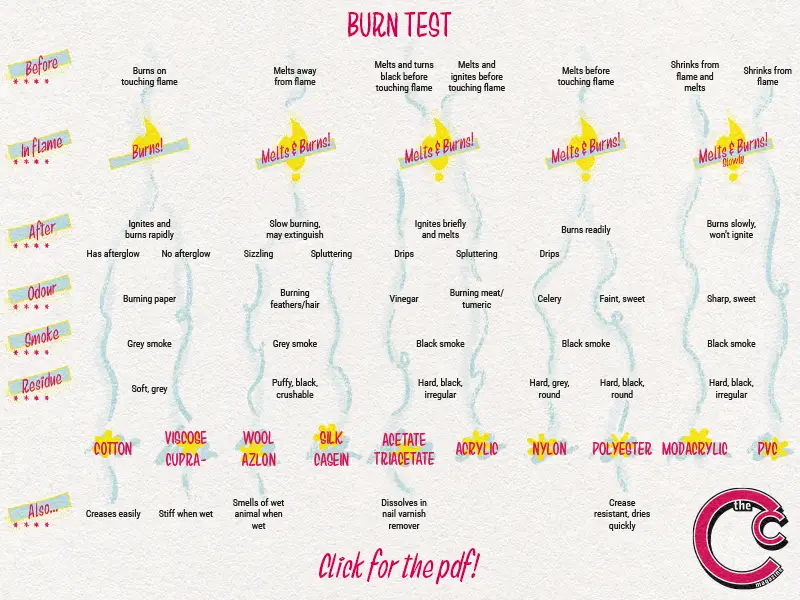
You’ll need to cut a small piece of fabric from the seam allowance your garment. You could pick the piece apart, separating it into warp and weft fibres, which may aid you in identifying a blended fabric.
Conduct the burn test over the sink or a metal dish. Preferably, use a lighter (matches will produce a smell that could mask the fibre smell) and use tweezers to safely hold the fibres.
TOP TIP: If possible, video the test on your phone so you can review if necessary.
First see what happens to the fibres when you move them close to the flame. Second, into the flame – do they burn easily? Third, what happens when you remove them from the flame? Did they ignite and continue to burn/melt? Also note the smell, the colour of the smoke and the consistency of the residue that is left at the end.
You may not be able to get a definitive result. The fibres themselves may be blended, or the fabric may have a finishing treatment, which will skew the results.
Check out YouTube for videos of burn tests.
(Some) finishing treatments
Anti-wrinkle
Wrinkle-free, holds pleats.
Brands: Korotron; Sharp-Shape; Sta-Prest; Vanopress.
Anti-stain
Repels stains or make stains easier to remove in wash.
Brands: Visa; X-It; Fybrite; Dual-Action Scotchguard; Come-Clean; Zepel.
Anti-shrink
Prevents shrinking in the wash
Brands: Sanforized; Rigmel; Pak-Nit; Penn-Set; Stable-Knit; Dylanize; Wurlan.
Sources
We try to use as many original/primary sources as possible when researching our vintage guides. Then, we dip into more contemporary sources and selling listings to see if our findings match up with photographs of labels on vintage garments.
All links were active at the time of publication and will open in a new tab.
Our key sources, which will contain more information than we’ve given here are:
A curator’s guide to synthetic garments – A contemporary source looking at each fibre, with comments on degredation and care.
Man-Made Textile Encyclopedia (1959), edited by J. J. Press – As well as being a source for each fibre, this book contains the original (?) burn test, that we suspect many contemporary versions were based upon. Near the end of the book is a very long list of fibre brand names, detailing their type, form, manufacturer and country. This includes fibres used for all sorts of purposes, so we didn’t choose to include them all here!
Man-Made Fibres (5th edition: 1970), by R. W. Moncrieff – Another excellent book and the 1975 edition is also available. Like the Encyclopedia, it includes a lot of information on each fibre type and its own very long list of brand names/manufacturers/countries.
Fiber Trade Names and Generic Terms (pdf) – U.S. Department of Homeland Security, June 2006. A list of fibre brand names and what type of fibre they are. A useful list but as a US source, you will find all the rayons listed as simply ‘rayon’.
Nylon Nostalgia. Who made that vintage fabric? – A contemporary source with a wonderfully long list of nylon brand names and corresponding images of adverts/labels.