
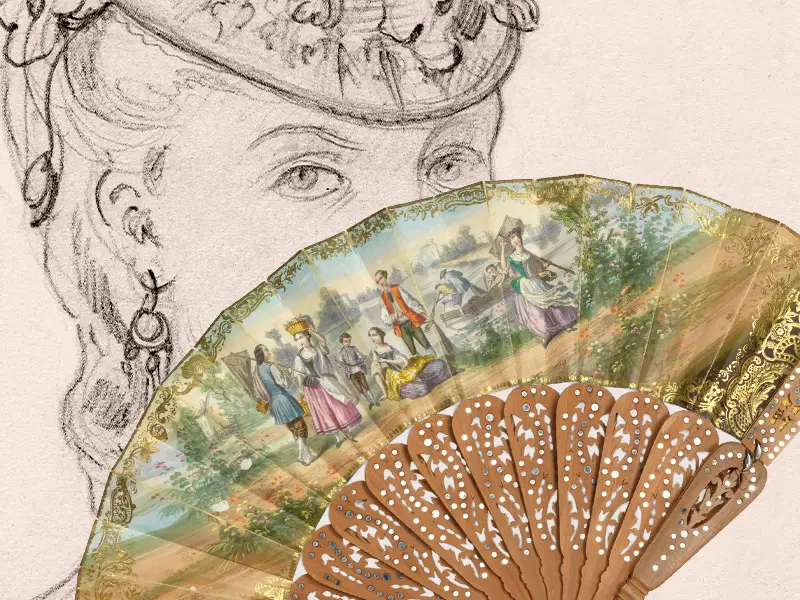
* Folding fans are thought to have arrived in France in 1533 with Catherine de’ Medici – an Italian who, through marriage, would become Queen of France.
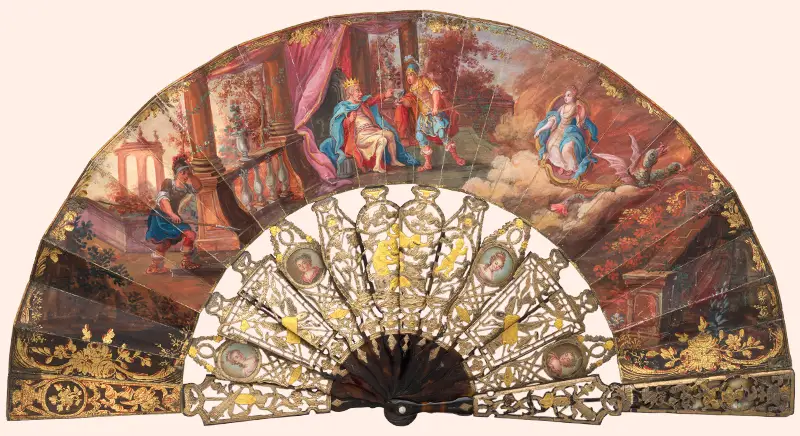
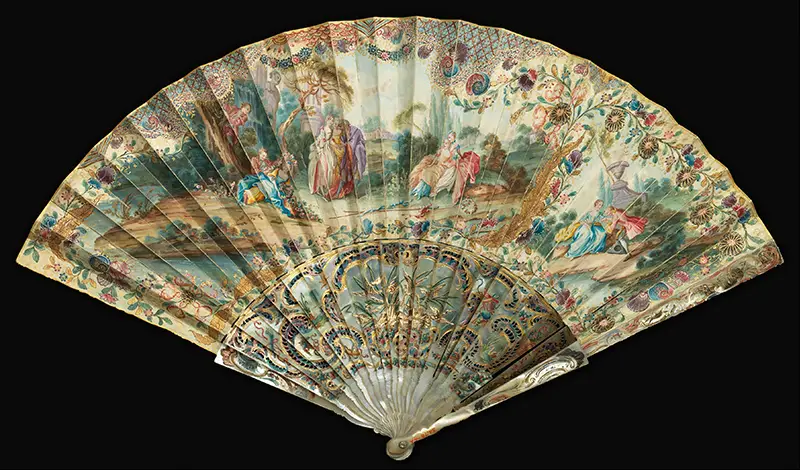
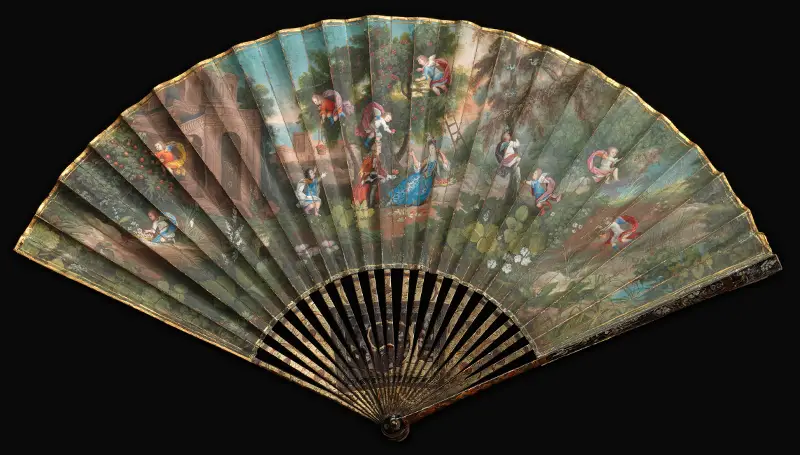
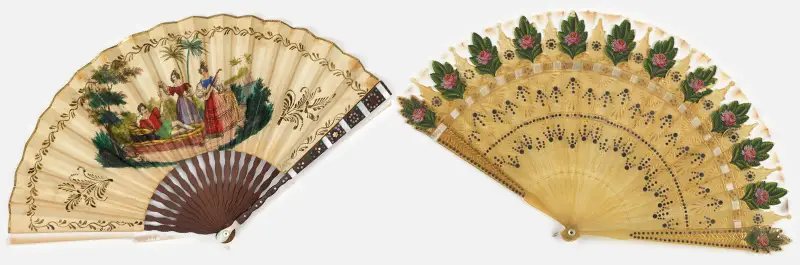
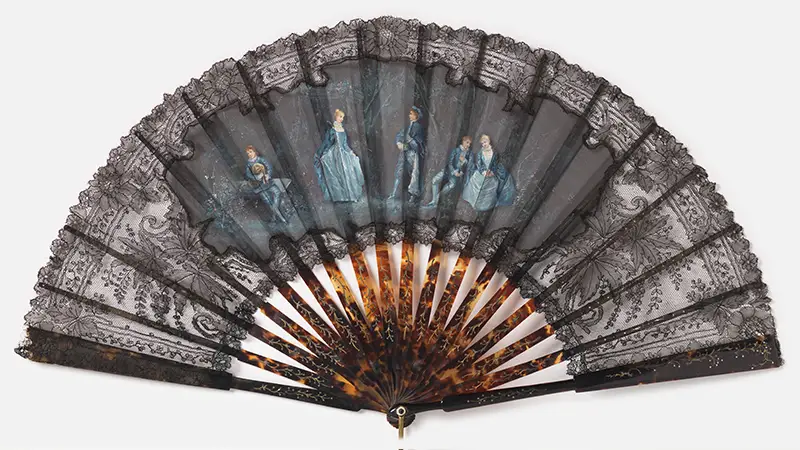
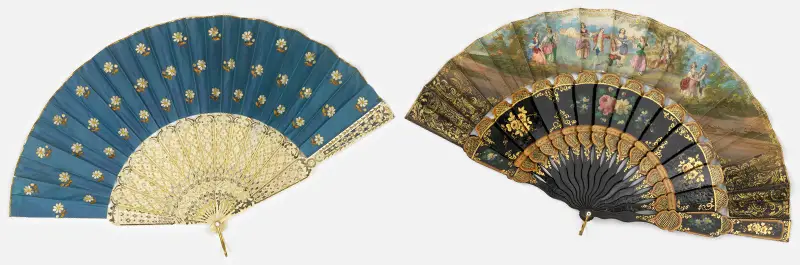
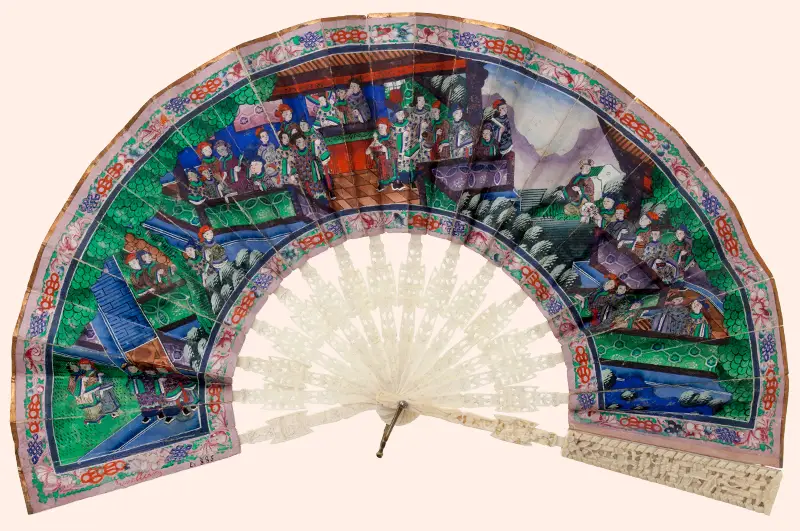
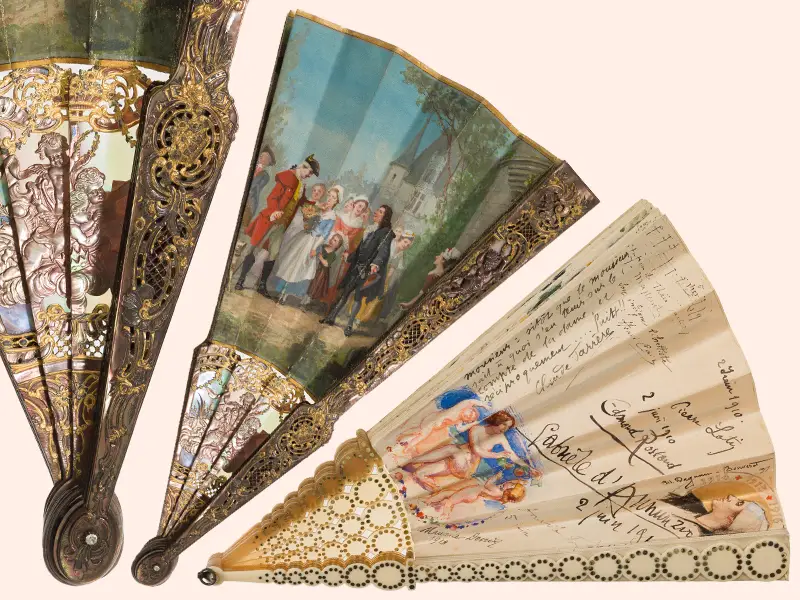
With summer here, we thought it would be nice to take a look at some fans. Nothing beats the convenience of a folding fan. These days, a battery-operated fan may seem the cooler option, but it will not be nearly as successful in expressing your British dissatisfaction with unreasonable weather conditions. In fact, the best way to make sure everyone knows you’re hot and bothered, is to use the impromptu hand fan. Perhaps this very copy of this magazine was waved furiously as you strolled around the antiques market. As multi-talented as this magazine is though, when it comes to beauty, it doesn’t match up to the fashionable fans of France in the 18th and 19th century – the era when the folding fan was an accessory for women of all classes. It is these pleated and brisé fans we share here.
Note re. citations: Images labelled ‘Met’ are fans held by The Metropolitan Museum of Art. Images labelled ‘SI’ are fans held by Smithsonian Institute.
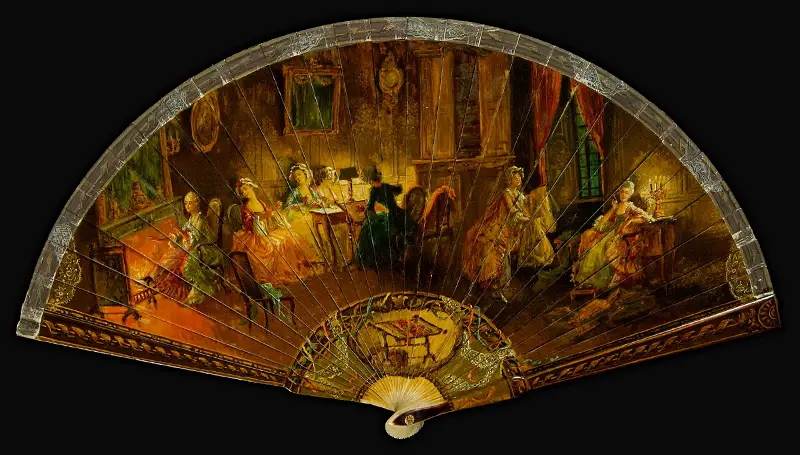
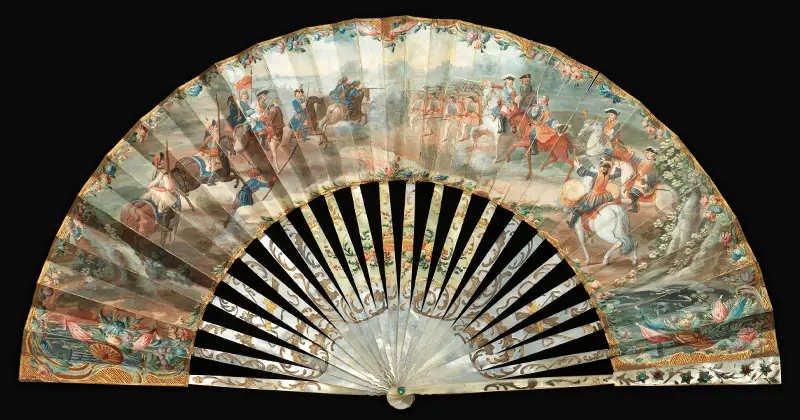
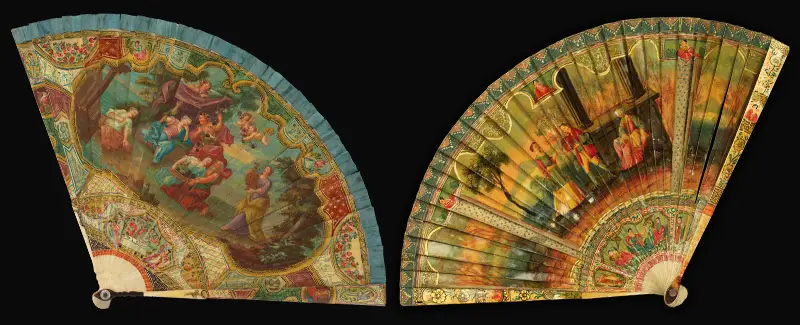
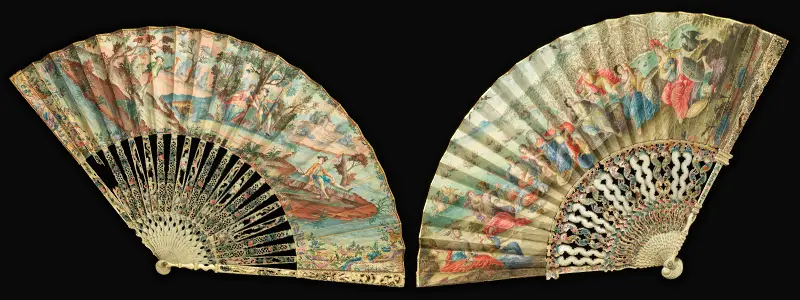
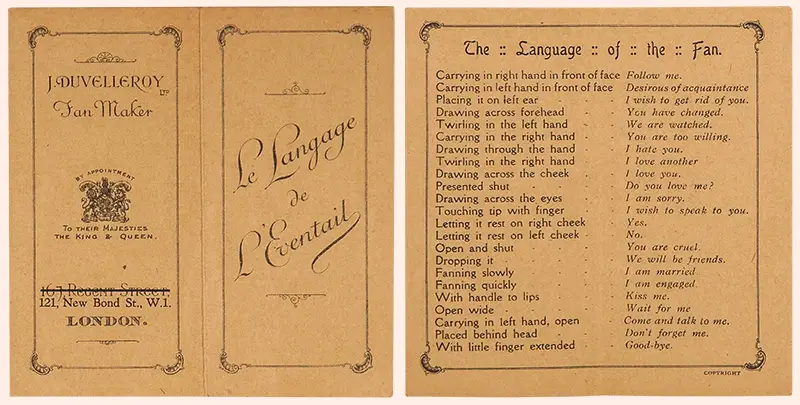
With a fan in hand, you may wish to indulge in some fan flirtations – the language of communicating to a potential suitor through the movement or placement of your fan. It makes the rounds every so often as historical fact, but really it’s the stuff of nonsense, the sort of thing that would cheerfully take a slot on This Morning. Other ‘languages’ also did the rounds in the 19th century, including the language of flowers, handkerchiefs, gloves and hats.
The language of fans, in its most widely shared form, was distrubted (late 19th C into the 1920s at least) as a promotional leaflet by the London branch of Duvelleroy fan-makers. Duvelleroy (more on them later) likely took their version from a German/Spanish text, but either way, it wouldn’t have been much use as a language, as varying versions were circulating in the following years with wildly different meanings. Best not to move in for the kiss.
Marie-Clémence Barbé-Conti.
A number of newspaper articles from the 19th and early 20th century made brief reference to a letter in The Spectator from 1711, describing several fan actions/exercises. What most of these articles failed to report, was how farcical this letter was, so we’ve shared (a lot of) the letter below.
Sales tactics aside, fans almost certainly could be used for flirtation (why else would this be satirised in 1711?), just not with the specifics the lists suggested. Put rather nicely, fans “may be made most expressive adjuncts to conversation”. ¹
There is some evidence these novelty languages were fairly widely known, one example being a US newspaper (reprinted in UK press) referring to them in a patronising little piece titled, “a talk with the girls.” It read, “there are many dangers that threaten girls nowadays, […] all the handkerchief and fan flirtations, and such like, are dangerous. You may only mean “fun” – innocent fun – but you will not always be understood.”²
If “innocent fun” is too innocent for your liking, then you could do as they (allegedly) did during the 18th century in London and Bath before their was such a thing as car keys – have gentlemen choose their partner for the evening by the “lottery of the fan”, where by all the ladies’ fans were placed into a hat for selection.³ Fancy that!
¹ Paisley & Renfrewshire Gazette – Saturday 06 August 1881, ² Banbury Beacon, 24th June 1882, ³ Newcastle Courant, 18th April 1896
Letter to The Spectator, 1711
Mr. Spectator,
Women are armed with Fans as Men with Swords, and sometimes do more Execution with them.
To the end therefore that Ladies may be entire Mistresses of the Weapon which they bear, I have erected an Academy for the training up of young Women in the Exercise of the Fan, according to the most fashionable Airs and Motions that are now practis’d at Court. The Ladies who carry Fans under me are drawn up twice a-day in my great Hall, where they are instructed in the Use of their Arms, and exercised by the following Words of Command, Handle your Fans, Unfurl your fans, Discharge your Fans, Ground your Fans, Recover your Fans, Flutter your Fans.
By the right Observation of these few plain Words of Command, a Woman of a tolerable Genius, who will apply herself diligently to her Exercise for the Space of but one half Year, shall be able to give her Fan all the Graces that can possibly enter into that little modish Machine.[…]
The next Motion is that of unfurling the Fan, in which are comprehended several little Flirts and Vibrations, as also gradual and deliberate Openings, with many voluntary Fallings asunder in the Fan itself, that are seldom learned under a Month’s Practice. This Part of the Exercise pleases the Spectators more than any other, as it discovers on a sudden an infinite Number of Cupids, Garlands, Altars, Birds, Beasts, Rainbows, and the like agreeable Figures, that display themselves to View, whilst every one in the Regiment holds a Picture in her Hand.
Upon my giving the Word to discharge their Fans, they give one general Crack that may be heard at a considerable distance when the Wind sits fair. This is one of the most difficult Parts of the Exercise; but I have several Ladies with me, who at their first Entrance could not give a Pop loud enough to be heard at the further end of a Room, who can now discharge a Fan in such a manner, that it shall make a Report like a Pocket-Pistol. I have likewise taken care (in order to hinder young Women from letting off their Fans in wrong Places or unsuitable Occasions) to shew upon what Subject the Crack of a Fan may come in properly: I have likewise invented a Fan, with which a Girl of Sixteen, by the help of a little Wind which is inclosed about one of the largest Sticks, can make as loud a Crack as a Woman of Fifty with an ordinary Fan.
When the Fans are thus discharged, the Word of Command in course is to ground their Fans. This teaches a Lady to quit her Fan gracefully when she throws it aside in order to take up a Pack of Cards, adjust a Curl of Hair, replace a falling Pin, or apply her self to any other Matter of Importance. […]
The Fluttering of the Fan is the last, and indeed the Master-piece of the whole Exercise; but if a Lady does not mis-spend her Time, she may make herself Mistress of it in three Months. I generally lay aside the Dog-days and the hot Time of the Summer for the teaching this Part of the Exercise; for as soon as ever I pronounce Flutter your Fans, the Place is fill’d with so many Zephyrs and gentle Breezes as are very refreshing in that Season of the Year, tho’ they might be dangerous to Ladies of a tender Constitution in any other.
There is an infinite Variety of Motions to be made use of in the Flutter of a Fan. There is the angry Flutter, the modest Flutter, the timorous Flutter, the confused Flutter, the merry Flutter, and the amorous Flutter. Not to be tedious, there is scarce any Emotion in the Mind which does not produce a suitable Agitation in the Fan; insomuch, that if I only see the Fan of a disciplin’d Lady, I know very well whether she laughs, frowns, or blushes.
I have seen a Fan so very angry, that it would have been dangerous for the absent Lover who provoked it to have come within the Wind of it; and at other times so very languishing, that I have been glad for the Lady’s sake the Lover was at a sufficient Distance from it. I need not add, that a Fan is either a Prude or Coquet according to the Nature of the Person who bears it. […]
The Spectator No. 102, 27th June 1711. www.gutenberg.org/files/9334/
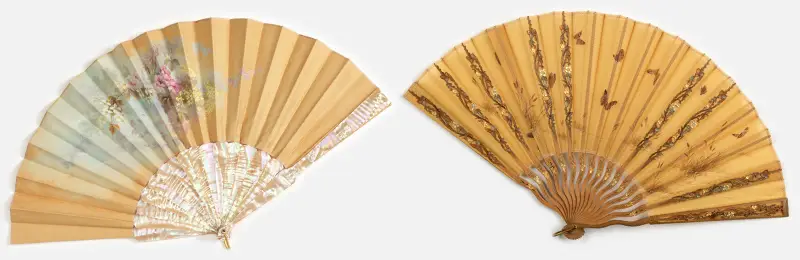
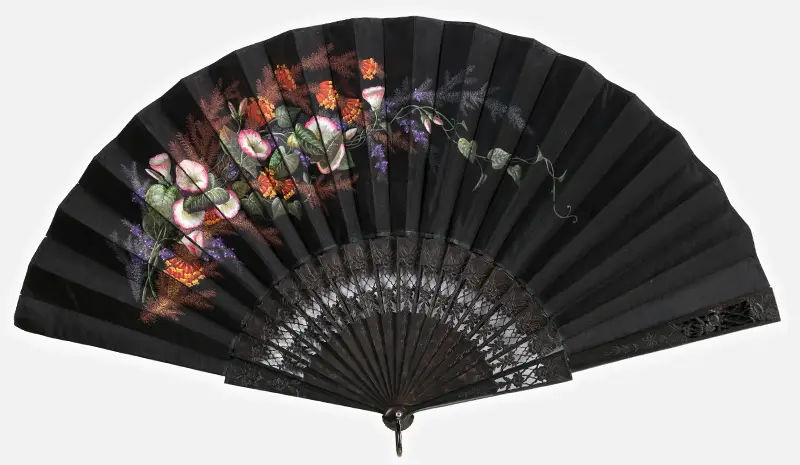
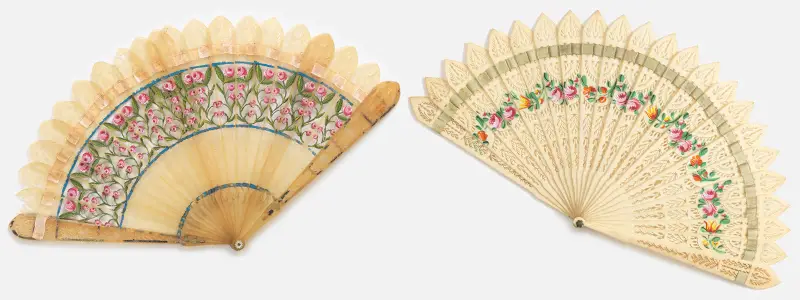
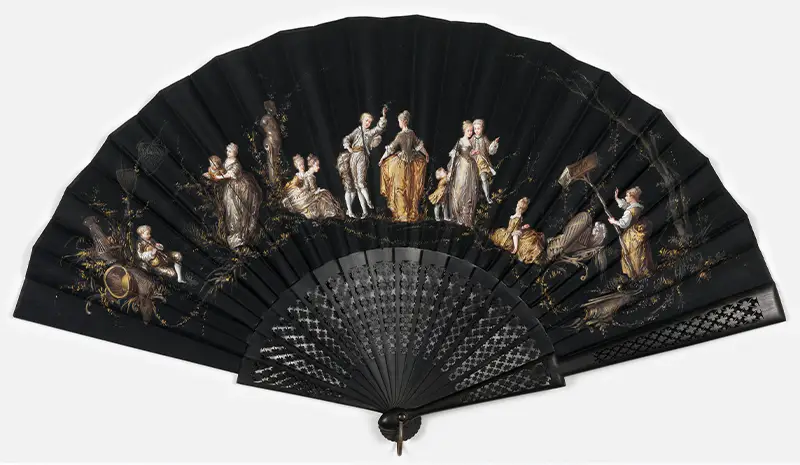
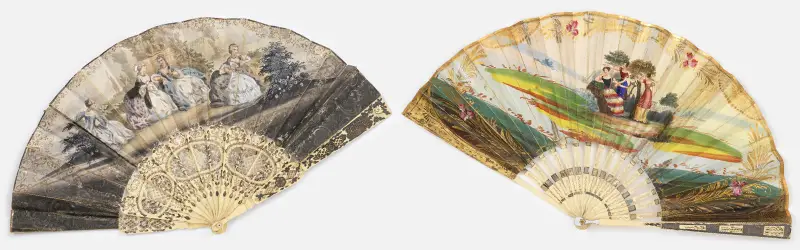
Fans are exceedingly a la mode at Paris; they are carried in walking, and in the carriage, as well as in the house. The are considered in fact, as part of one’s self.
Monmouthshire Merlin, 9th June 1838.
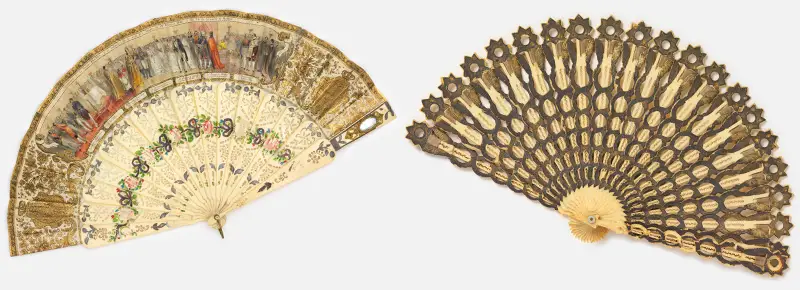
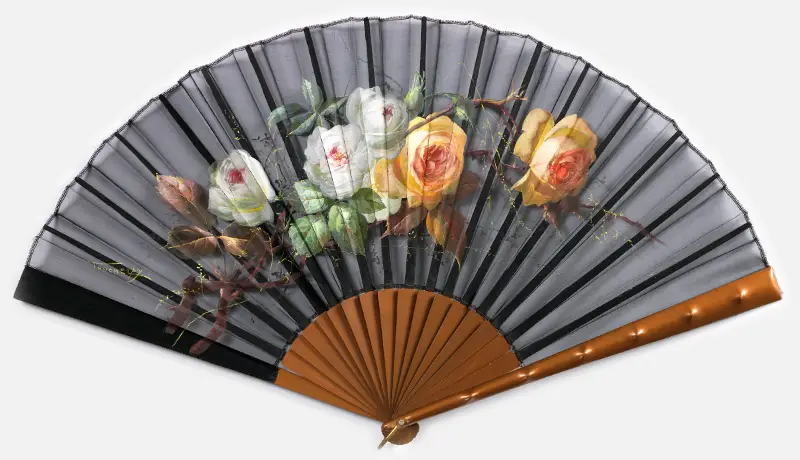
Maison Duvelleroy
This Parisian fan-makers was founded by Jean-Pierre Duvelleroy in 1827, at a time when fan-making was out of fashion and primarily for the export market. Duvelleroy should be credited with bringing fans back into vogue, he was the big name in fan-making, being awarded the Légion d’Honneur, a prize medal from the Great Exhibition of 1851, and off the back of that, being appointed supplier to Queen Victoria. Duvelleroy opened a London maison, run by one of his two sons. It proved to be popular:
Though M. Duvelleroy may challenge the world to equal him in the fine art of fan-making, and may therefore be considered in the highest sense the fanmaker of chic, it is a fact that the girl who has only a sovereign to spend can buy from him a perfectly charming fan for that modest sum. There is no bad art to be found with M. Duvelleroy, 167, Regent Street; therefore the most critical may be pleased – nay, even delighted, with the inexpensive fan that hails from that little fan palace at the corner of New Burlington Street and Regent Street. “The Pansy,” “The Iris,” “The Chrysanthemum,” “The Lilac and Violet” are all lovely fans, with a mass of blooms painted on the left of the fan and a most dainty mount of imitation ivory, and they are all priced at either 20s. or 21s., in which low-priced range may be found many others painted with usual pastoral scene of swain and shy maiden, with cupids in attendance. Any of these would make a charming little gift and should be purchased, if only as a mark of appreciation from us of the great Duvelleroy’s consideration for the limited purse. About M. Duvelleroy’s costly fans there is much more to say, for never were they more charming, their mounts more beautifully carved, or their paintings more finely executed. An exquisite thing in fans is that entirely formed of ivory and hand-painted in the “Vernis Martin” style. […] It is, in fact, a curio for a cabinet – something almost too fine for the ordinary uses of the fan. In Brussels lace there are some lovely things to be found at 167, Regent Street; some of them simulating an outspread spray of flowers, in one the puff ball, in another the tulip, and so on. With the lace gown the woman fashionable will often desire the lace fan. She has but to step into M. Duvelleroy’s and find it awaiting her. Others are there in black Chantilly, and others with the leaf formed by appliques of chicken skin on black mousseline and silk, the chicken skin having on it the hand-painted pastoral scene inseparable from this type of fan. For the fan, therefore, whether simple or sumptuous, we have at our door M. Duvelleroy, 167, Regent Street.
The Gentlewoman, 18th March 1899.
Fantastical
Of the hundreds of fans we selected from for this feature, this was the stand out. Do you agree? This Duvelleroy fan would have been intended to be one of their finest offerings, made especially for the Exposition Universelle of 1900 (Paris Exhibition) and donated to the Musée Carnavalet seven years later, where it currently resides.
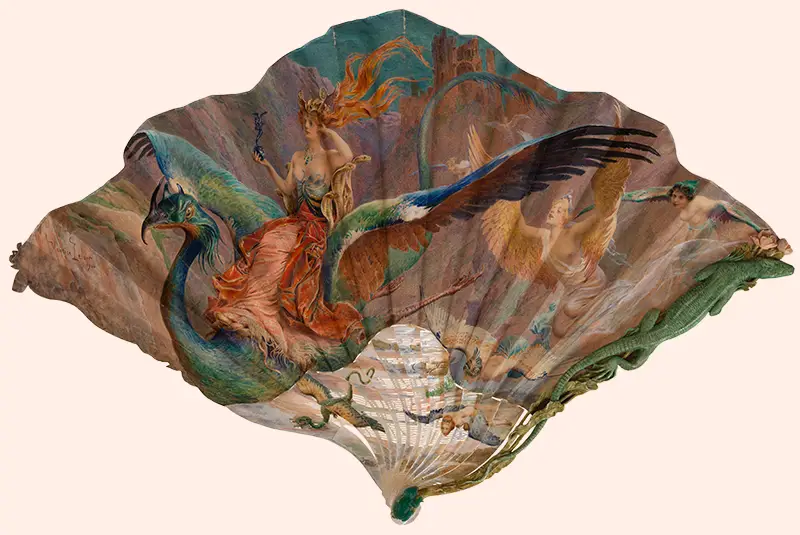
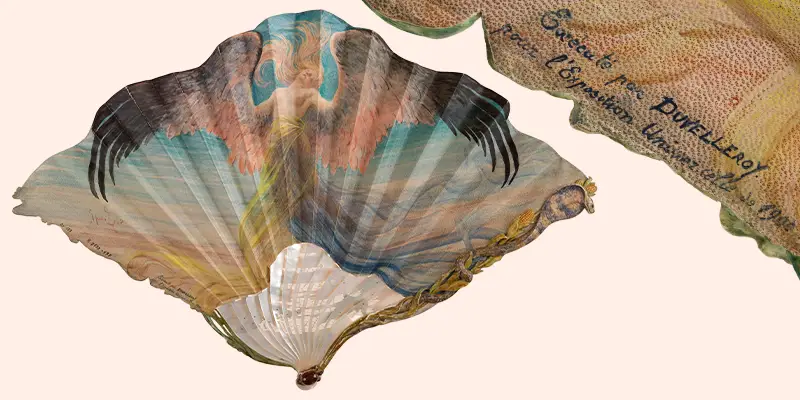
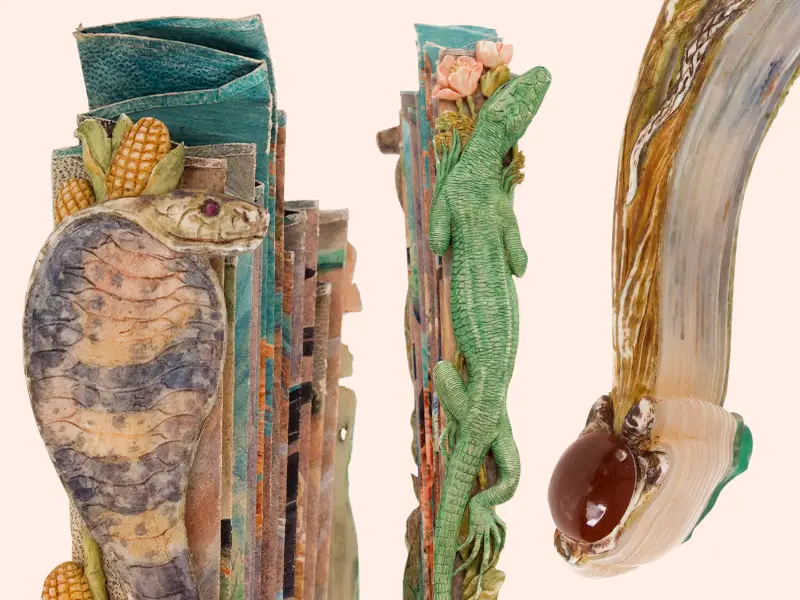
The fan’s leaves are made from leather/skin and painted in watercolour and gouache on both sides. The fan depicts a woman sitting on a throne made of six cobras, on the back of a phoenix. On her head sits a chameleon and her bodice is shaped like a dragonfly. Semi-naked flying women follow her, as they all fly above a fantastical mountainous landscape. On the reverse is a single winged woman. The twelve mother-of-pearl sticks are painted with a continuation of the artwork from the leaves. The ivory guards are shaped into a lizard and cobra emerging from fauna, adorned with a tortoise and frog at their bases.
The artwork is signed Maurice Leloir, a prominent and prolific French illustrator/artist, who, like Duvelleroy, was awarded the Légion d’Honneur.
Leloir was reputed to be “the greatest living authority on the customs and manners of the seventeenth century”, and was invited by Douglas Fairbanks to work on the 1929 film The Iron Mask, to create the costumes and to “pass upon the authenticity of settings and art.” One of Leloir’s many illustrations of costumed ladies in the 1860s was used as the background art on the first image on this page.
“A very refreshing invention.”
Electric, battery and mechanical fans had arrived in homes, businesses and even pockets at the end of the 19th century, with numerous similar designs being patented both here and abroad. They solved the problem of hand-fans being seen as effeminate with early advertising targeting men. They were also put to use in a variety of business uses such as cooling restaurants, airing sick rooms and even, with the attachment of large tubes, drying women’s hair at the hairdressers, replacing the “laborious hand-fanning process.”
Not everyone was happy with the invention. At first glance, I thought the following 1883 newspaper article to be satirical, but sandwiched between the search for three Irish political assassins and a report from the House of Commons, it would appear to be genuine its complaint. You can’t please everyone!:
It is high time that the most powerful section of the population protested against the ravages of science. An ingenious gentleman, Mr. Colston Fear, of Bristol, has invented an electric fan. This “is mounted on an ornamental pedestal, and is kept in motion by a hidden mechanical arrangement, workable either by a spring motor or the electric motor. The application of electricity as the motive power secures a long continuance of the fan’s action without the labour of winding-up.” Now to the male community this seems a very happy idea. One or two of these electric fans in a heated drawing-room after dinner will be highly grateful to the masculine epidermis. If a man does not feel that he gets his fair share of coolness, he can stand near the apparatus on the pretext of examining its operations. But to the ladies all this must be provoking to the last degree. They, too, can look at the electric fan, but they cannot lounge around it for the best part of the evening. They want to sit in corners and fan themselves, or better still, compel the attendant swains to perform this operation for them. But the electric fan will put them out of countenance. A base automatic contrivance, which fans everybody impartially, is destructive of fans. Imagine a happy pair trying to flirt behind an electric motor! The convenient fanning in a corner which now seems natural and innocent enough, cannot be carried on with any show of discretion if a wretched machine, or two or three wretched machines, are planted about the room doing all the needful work in the way of cooling the human system. We shall not be surprised to learn that the ladies as a body have set their faces against Mr Fear’s invention.
Eastern Evening News, 3rd March 1883
… Finally, it is better never to be in a hurry on a very hot day or attempt to run or walk fast. One should take plenty of time, and stroll along quietly on the shady side of the way.
Westminster Gazette, 12th July 1923